
The Influence of Gas Flow on Flow Measurement: Laminarity, Turbulence, and Straight Pipe Runs


The accuracy of gas flow measurement directly depends on the flow profile at the installation point of the instrument. Any local flow disturbance — an elbow, tee, valve, or diameter transition — creates perturbations that distort the velocity profile. These distortions can persist for dozens of pipe diameters, and if a flow meter is installed in an unstabilized flow zone, measurement error can reach tens of percent. Therefore, the question of the required length of straight pipe runs upstream and downstream of a flow meter is not a formality but a key condition for reliable gas metering.
In this article, we will thoroughly examine how gas flow regimes affect flow meter performance, what straight pipe run requirements are imposed by different types of instruments, and what to do when straight pipe runs are critically insufficient.
Laminar and Turbulent Flow: Why It Matters
The flow regime of gas in a pipeline is determined by the Reynolds number (Re) — a dimensionless quantity that depends on flow velocity, pipe diameter, and the kinematic viscosity of the gas. For smooth straight pipes, the critical Re value is approximately 2300: below this value, the flow is laminar (layered, streamlined); above it, turbulent.
In laminar flow, gas moves in parallel layers without mixing, and the velocity profile takes the shape of a parabola with a maximum on the pipe axis and zero velocity at the walls. Such a profile is extremely sensitive to any disturbances: even a small obstruction disrupts it, and restoration to a stable state requires a significant length of straight pipe. Laminar flow is characteristic of low velocities, high viscosities, or small pipe diameters, but it is rarely encountered in industrial gas flow measurement — most practical applications involve turbulent flow.
In turbulent flow, gas particles move chaotically, mixing intensively. The velocity profile becomes flatter in the central region and drops sharply in the near-wall layer. Turbulent flow is more resistant to disturbances, but it also requires a certain length to stabilize after local flow disturbances. It is important to note that at Re > 20,000, turbulence becomes fully developed, and many flow meters (e.g., vortex meters) operate stably precisely in this region.
The key takeaway: most flow meters are calibrated and specified under conditions of fully developed turbulent flow. If an instrument is installed in a zone with a distorted profile (e.g., immediately after an elbow), its readings may systematically deviate from true values, even if the instrument itself is perfectly functional.
Straight Pipe Run Requirements for Different Types of Flow Meters
Each type of flow meter responds differently to flow disturbances. Let us examine the requirements for the main types of instruments used for gas flow measurement.
Differential Pressure Flow Meters (Primary Elements)
This class includes orifice plates, nozzles, Venturi tubes, and averaging pitot tubes (e.g., Annubar). This is the most demanding type of flow meter in terms of straight pipe runs. Standard primary elements are calibrated under conditions of fully developed turbulent flow with an axisymmetric velocity profile; therefore, any deviation from this ideal introduces additional measurement uncertainty.
According to generalized data, straight pipe run requirements upstream of an orifice plate range from 5 to 80 DN depending on the type of local flow disturbance and the beta ratio (β), and downstream from 2 to 8 DN. Requirements for nozzles are similar: upstream — 5–80 DN, downstream — no less than 4 DN. For Venturi tubes — upstream 5–30 DN, downstream no less than 4 DN. Averaging pitot tubes are less sensitive: they require 3 to 25 DN upstream and 2–4 DN downstream.
Turbine Flow Meters
Turbine gas meters measure flow based on the rotational speed of a rotor; therefore, the presence of swirl is critical for them. Standard requirements: straight pipe run upstream of the meter — at least 5 DN, downstream — at least 3 DN. However, in industrial settings, especially when control valves are present, it is recommended to increase the upstream run to 10–20 DN.
Some modern turbine flow meter models are equipped with built-in flow straighteners or are supplied with spool pieces that ensure flow stabilization — in such cases, additional straight pipe runs are not required.
Vortex Flow Meters
Vortex flow meters measure the frequency of vortex shedding behind a bluff body. They are extremely sensitive to flow swirl and velocity profile asymmetry, as these factors directly affect the stability of vortex formation. Straight pipe run requirements for vortex flow meters are among the most stringent: 10 to 40 DN upstream and at least 5 DN downstream.
When two elbows in the same plane are present upstream of the installation point, the straight pipe run must be at least 25 DN upstream and at least 5 DN downstream. A control valve must be installed at a distance of at least 5 DN downstream of the flow meter. If the valve must be placed upstream of the flow meter, the upstream straight pipe run must be at least 50 DN.
Some manufacturers implement a straight pipe run correction function, allowing the required upstream length to be reduced to 10 DN through built-in compensation algorithms.
Ultrasonic Flow Meters
Ultrasonic flow meters measure the difference in transit time of an acoustic signal traveling with and against the flow. They are sensitive to the velocity profile, especially multi-path systems. Straight pipe run requirements: 10 to 50 DN upstream and at least 5 DN downstream. The specific value depends on the type of local flow disturbance and the number of measurement paths: single-path instruments require greater lengths, while multi-path instruments (especially those with chordal arrangements) are less sensitive.
An important requirement: the internal diameter of the straight pipe runs must be equal to the nominal bore of the primary element with a tolerance of ±2–2.5%. The internal surface roughness must be no worse than that of new pipes. Installation of devices that cause distortion of the axial flow symmetry is not permitted on the straight runs.
Thermal Dispersion (Thermal Mass) Flow Meters
Thermal mass flow meters measure gas mass flow based on the cooling of a heated sensing element. They are less sensitive to flow profile than vortex or ultrasonic meters, but still require straight pipe runs for correct operation. The recommended length upstream of the instrument is at least 8 internal diameters of the flow meter's flow channel. More general recommendations: 10–15 DN upstream and 5–10 DN downstream. For gas and steam measurement, it is advisable to increase the recommended straight pipe run length by a factor of 1.5 compared to liquids due to compressibility and more complex flow dynamics.
Coriolis Flow Meters
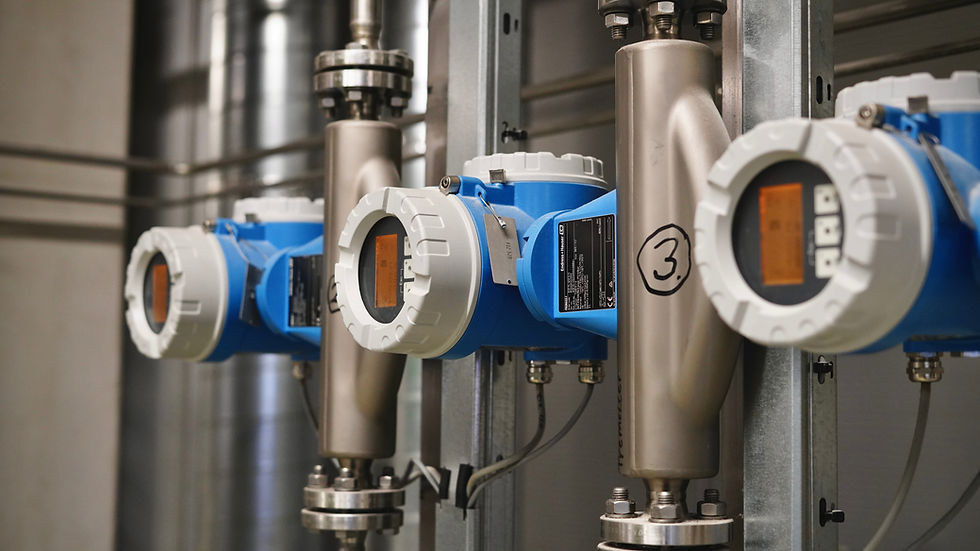
Coriolis mass flow meters measure mass flow directly using the Coriolis effect in oscillating tubes. This is the least demanding type of flow meter regarding straight pipe runs. Under the most favorable conditions, they require no straight pipe runs upstream or downstream. This is because Coriolis flow meters measure mass flow directly through the phase difference of oscillations and are largely unaffected by velocity distribution.
However, in special situations (two-phase flow, strong pulsation, close proximity of flow disturbances), it is recommended to provide a straight pipe run of 3–5 DN upstream of the meter.
Rotameters and Positive Displacement Meters
Rotameters (variable area flow meters) require practically no straight pipe runs: 0–5 DN upstream and no requirements downstream. Positive displacement meters (rotary, diaphragm) also do not require straight pipe runs.
Summary Table of Straight Pipe Run Requirements for Gas Flows
Flow Meter Type | Upstream Straight Run (DN) | Downstream Straight Run (DN) | Notes |
Orifice Plate | 5–80 | 2–8 | Depends on β and disturbance type |
Nozzle | 5–80 | ≥4 | Similar to orifice plate |
Venturi Tube | 5–30 | ≥4 | Less dependent on β |
Averaging Pitot Tube | 3–25 | 2–4 | Less sensitive to disturbances |
Turbine | 5–20 | 3–10 | Swirl is critical |
Vortex | 10–40 | ≥5 | Most sensitive to disturbances |
Ultrasonic | 10–50 | ≥5 | Depends on number of paths |
Thermal Mass | 8–15 | 5–10 | Increase by 1.5x for gas |
Coriolis | 0–3 | 0–1 | Minimal requirements |
Rotameter | 0–5 | 0 | No strict requirements |
Positive Displacement | 0 | 0 | Straight runs not required |
What to Do When Straight Pipe Runs Are Insufficient
In real industrial conditions, straight pipe run lengths are often insufficient due to equipment layout, limited space, or the specifics of existing piping configurations. There are several proven methods to address this issue.
1. Flow Straighteners and Flow Conditioning Devices
A flow straightener is a device that eliminates or significantly reduces flow swirl upstream of a flow meter. The operating principle is based on dividing the flow into numerous small jets passing through a grid or tube bundle, which breaks up large eddies and accelerates the formation of an axisymmetric velocity profile.
A tube bundle flow straightener consists of a bundle of parallel tubes (at least 19 pieces) welded together. The tube length must be at least 10 times their diameter. It effectively eliminates flow swirl but is difficult to clean as it is welded directly into the pipeline.
The Zanker flow conditioner is one of the most effective types. It consists of a perforated plate with holes, behind which are channels formed by the intersection of a series of plates. The Zanker plate conditioner includes 32 holes arranged in a symmetrical circular pattern. The pressure loss coefficient is about 3–5, which is relatively low. The Zanker conditioner eliminates both swirl and flow asymmetry, making it a versatile solution.
The Sprenkle flow conditioner consists of three perforated plates arranged in series. The total area of the holes must be more than 40% of the pipe cross-section. The pressure loss coefficient is 11–14 depending on the presence of chamfers on the holes.
Flow straighteners are primarily used with vortex and ultrasonic flow meters. Their installation can reduce the required straight pipe run length by several times, although the exact reduction requires analysis of the specific piping configuration.
2. Selecting a Flow Meter with Straight Run Correction
Some modern vortex flow meter models are equipped with a straight pipe run correction function. Built-in algorithms, based on a comprehensive study of accuracy characteristics under various flow disturbances, allow the required upstream straight run length to be reduced to 10 DN.
3. Installation in a Vertical Pipe
Vortex and some other flow meters can be installed in vertical pipes. When measuring gas flow, the flow direction is not restricted. If the gas contains a small amount of liquid (e.g., droplet moisture), the flow should be directed upwards so that liquid does not accumulate in the measurement zone.
4. Switching to a Coriolis Flow Meter
If space is critically limited and the budget allows, the optimal solution may be to replace the flow meter with a Coriolis meter. As noted above, it practically requires no straight pipe runs and provides high accuracy in measuring gas mass flow regardless of the flow profile.
5. Metering Run Configuration
If none of the above methods are applicable, one must strive for the maximum possible straight pipe run length while observing the following rules:
Control valves are always installed downstream of the flow meter, not upstream.
Filters and strainers are placed upstream of the straight pipe run (for turbine meters — upstream of the flow straightener).
Avoid installing the flow meter near sources of vibration (pumps, compressors).
The piping upstream and downstream of the flow meter must be concentric with the instrument; axis deviation must not exceed 0.5 DN.
Conclusion
Proper conditioning of gas flow upstream of a flow meter is not merely a formal requirement of regulatory documents but a physical necessity upon which measurement accuracy directly depends. Neglecting straight pipe run requirements is one of the most frequent and costly mistakes in the design of gas metering stations. Saving on straight run length inevitably results in systematic measurement error, which can range from several percent to tens of percent.
Key Takeaways:
The most demanding in terms of straight pipe runs are vortex, ultrasonic, and differential pressure flow meters (especially orifice plates). For these, the upstream straight run can reach 40–80 DN.
The least demanding are Coriolis flow meters (0–3 DN) and positive displacement meters (0 DN).
Turbine and thermal mass flow meters occupy an intermediate position (5–20 DN).
When space is limited, it is necessary to use flow straighteners (Zanker, Sprenkle, tube bundle), select flow meters with correction functions, or switch to Coriolis instruments.
Control valves must always be located downstream of the flow meter.
Remember: even the most accurate and expensive flow meter, installed without observing straight pipe run requirements, becomes merely an indicator whose readings cannot be used for commercial metering or process control. Investments in the proper design of the metering run always pay off through the reliability of the data obtained.

Comments