
The Analytical System Couldn't Take It: How Extreme SO₂ and Dust Concentrations Destroyed Equipment at a Copper Smelter


This case occurred at one of the largest copper smelters in Central Asia. The project seemed to have been prepared by all the rules: the customer conducted pre-design surveys, completed detailed questionnaires, and transmitted all the data to the manufacturer. Moreover, a supplier representative even visited the site. However, this visit was limited to a visual inspection only — there was simply no opportunity to conduct a more in-depth survey, take measurements, or test under different operating modes. As a result, an extractive gas analytical system was designed and supplied based on incomplete data. Commissioning work ended almost as soon as it began: the system failed within a few hours. How could this happen, and why is a visual inspection catastrophically insufficient? We analyze it in this article.
The Conditions the Equipment Faced
Copper smelting production always presents extreme conditions for gas analytics. But here, the figures were staggering. The pre-design survey recorded the following:
Dust concentration — approximately 20 g/m³. This is not just a lot; it is a colossal dust load under which standard sample conditioning systems are incapable of operating.
Sulfur dioxide (SO₂) concentration — on the order of 400,000 mg/m³ (i.e., 400 g/m³). At such a concentration and in the presence of moisture, the acid dew point shifts to a very high temperature region — approximately 215 °C.
Gas stream temperature — approximately 300 °C.
This meant that to prevent condensation and preserve the sample unchanged, the entire sampling system had to be maintained at temperatures well above 215 °C. The manufacturer understood this: the probe was set to heat up to 270 °C, and the analyzer's measurement cell to 235 °C. The temperature regime seemed to have been chosen correctly.
What Was Installed and How It Was Supposed to Work
A multi-component extractive system was delivered to the site. It included:
A heated sampling probe (but without a coarse filter).
A heated sample line for transporting the sample from the probe to the analytical cabinet.
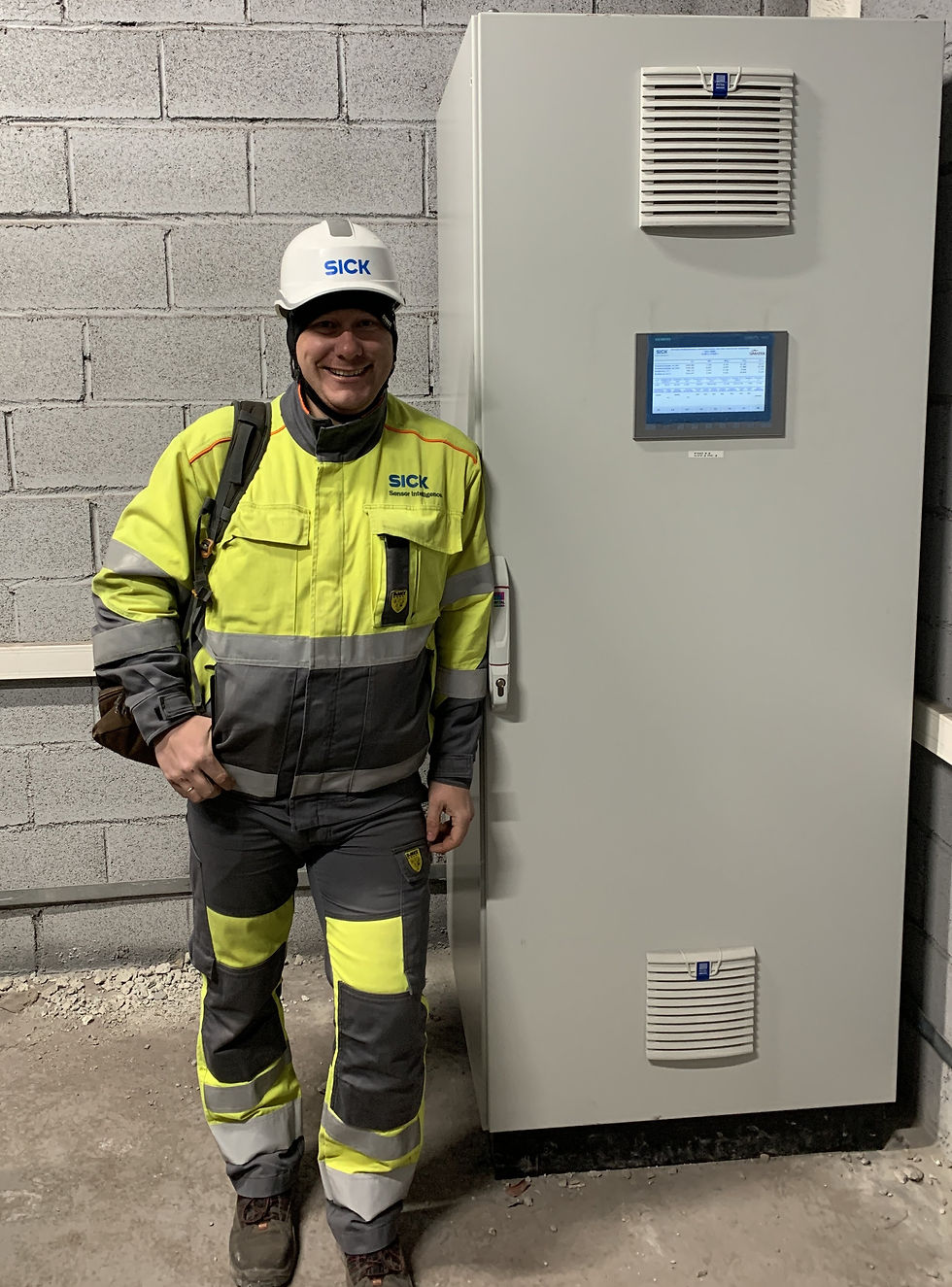
The analytical cabinet itself, containing a photometric analyzer capable of measuring up to six gas components simultaneously (including SO₂, CO, CO₂, NOₓ) and processing signals from external sensors.
A sample conditioning system, including fine filters, a dryer, and flow regulators.
The operating principle of the system is extractive, "hot-wet": the sample is extracted from the flue gas duct, transported along a line maintained above the dew point, and enters the measurement cell. This is a standard solution for aggressive environments, but only on the condition that the sample conditioning system is correctly designed and capable of handling the dust load.
Chronicle of a Catastrophe: From Commissioning to Complete Failure
Only a few hours passed from the moment gas was introduced into the system. Here is what happened.
Reason No. 1: Tubing Diameter Too Small and Lack of a Filter on the Probe
The sample tubing connecting the probe to the sample conditioning system was selected with too small a diameter. With a dust load of 20 g/m³ and the sample flow rate required for correct analyzer operation, the linear gas velocity in the tubing proved insufficient to transport particles in suspension. Dust began to settle on the walls, rapidly narrowing the cross-section. The situation was aggravated by the absence of a coarse filter on the probe itself — dust freely entered the tubing and settled inside. Within a couple of hours, the tubing was completely clogged — the sample stopped reaching the analyzer.
Reason No. 2: Poor Thermal Insulation and Condensate Formation
The heated line was installed with deficiencies: the thermal insulation joints had gaps, and in some places, the heating cable did not provide uniform warming. As a result, the temperature in certain sections fell below the critical mark of 215 °C, and condensate began to form — highly concentrated sulfuric acid. However, unlike typical cases, the acid did not have time to corrode the inner surface of the tubing (it was made of corrosion-resistant material). Instead, the condensate provoked even faster adhesion of dust to the walls, acting as a binder and accelerating the clogging of the sample path.
Reason No. 3: Dust Deposition on the Measurement Cell Windows
Some of the fine dust that managed to bypass the clogged sections still reached the analyzer's measurement cell. Despite the cell being heated to 235 °C, dust settled on the optical windows. The system uses a photometric principle: radiation from a source passes through the gas cell and reaches a detector. Contamination of the windows led to a sharp drop in signal intensity. The automatic gain control system tried to compensate for the losses, but its reserve was insufficient. The analyzer triggered an error.
Where the Fatal Mistake Was Made: Visual Inspection Instead of a Comprehensive Survey
Formally, everything was done correctly: pre-design survey, questionnaires, a site visit by a supplier representative. But this visit was limited to a visual inspection of the sampling point. There was neither time, nor opportunity, nor perhaps the appropriate portable equipment to take measurements, test the sampling under different furnace operating modes, or assess the particle size distribution of the dust.
As a result, key information remained unseen:
Real dust load dynamics: how dust concentration changes during transient modes, furnace start-ups, and shutdowns.
Particle size distribution of the dust: fine, cohesive dust behaves differently than coarse, abrasive dust.
Actual duct geometry and accessible sampling points: how representative the sample is, whether there are swirls or dead zones.
The questionnaire and visual inspection failed to convey these nuances. The system configuration decision made on their basis proved fatal.
What the Supplier Is Offering Now and Why It Won't Work
After the incident, the supplier is ready to replace the failed parts: optical components, tubing, possibly part of the sample conditioning system. They are acting within warranty obligations, but the problem is that replacing components without a fundamental redesign of the entire system will not yield results. In a few hours, or days at most, the situation will repeat: the tubing will clog with dust again, some of it will again reach the cell windows, and the expensive components will fail once more.
What Should Have Been Done Initially: The Correct Algorithm of Actions
To avoid such a fiasco, a different approach was necessary:
Organize a comprehensive technical survey with measurements. The engineer's site visit must include not only a visual inspection but also instrumental measurements using portable gas analyzers and dust monitors under different furnace operating modes. This is the only way to obtain a real picture of peak loads.
Design the sample conditioning system considering the extreme dust load. At 20 g/m³, standard solutions do not work. It was necessary to:
Increase the diameter of the sample tubing to ensure sufficient gas velocity.
Mandatorily install a coarse filter directly on the probe (or, better yet, a preliminary cyclone separator).
Provide an automatic purge system for the sample path to remove settled dust.
Ensure high-quality installation of the heated line. Thermal insulation must be continuous and airtight, and the temperature must be monitored along the entire length with a margin above the dew point (in this case, consistently above 215 °C).
Conduct extended testing during the commissioning phase. Before introducing real gas, the system should have been tested with an inert gas simulating the dust load to identify weak points.
Conclusions
This case is a classic example of how even having a specialist visit the site does not guarantee success if that visit is limited to a visual inspection. Completing questionnaires and a cursory glance at the sampling point are no substitute for a full-fledged engineering survey with measurements and testing.
Key Lessons:
Pre-design surveys must be comprehensive. A visual inspection is insufficient. Instrumental measurements under different equipment operating modes are necessary.
Standard solutions do not work under extreme dust concentrations. An individual design of the sample conditioning system is required, with increased tubing diameters, mandatory preliminary cleaning, and enhanced thermal insulation.
Saving on engineering surveys results in multiple losses. The cost of a full-fledged site visit with measurements is incomparable to the expense of replacing failed equipment and the losses from monitoring system downtime.
Simply replacing broken parts without changing the system design is a road to nowhere. Unless the root cause is eliminated, failures will repeat again and again.
I hope this analysis helps you avoid similar mistakes when implementing environmental monitoring projects. Remember: a gas analytical system is not just a device but a complex engineering solution, the success of which is determined long before the equipment is delivered, at the stage of a detailed and, crucially, instrumental site survey.


Comments